

The Weak-Kneed Warrior

“I’m not a weak-kneed warrior! My knees are perfectly capable!” I protest, angrily.
“No – I said weekend warrior!” someone clarifies, understandably annoyed.
“Well, that’s strong, too!”
Maybe that joke would work better with a verbal delivery. Or maybe not at all.
—————————————————————
Mile 26 of your first 31-mile race is an exciting place to be. If you have previously run a marathon, once you pass the 26.2-mile mark, you are officially in ultramarathon territory, and every step you take is the furthest you’ve ever run. In just 5 short miles, I’ll be crossing the finish line, strutting with the confidence of Gisele and the graceful elegance of a baby giraffe. But that was in 5 short miles. At the Run Woodstock Freak 50k, I was still cruising.
Two laps of the hilly 16-mile loop through the Michigan’s Pinckney Recreation Area made up my first ultramarathon, and my first trail race longer than 18 miles. My nutrition was dialed in, fueled by gels, Pop Tarts, and Uncrustables (I’m a bit of a health nut), and my hydration was working perfectly, swapping my vest flasks at the halfway point to minimize aid station stops. Everything was in order. My legs still felt strong.
Around mile 28, my hip flexors began to ache. Not enough to slow me down, but enough to make me uncomfortable. At roughly the same time, I started closing in on a racer who had been in front of me the entire race. He entered my line of sight about fifteen minutes earlier, but catching someone on the trails takes time. Unlike in empty late-night parking garages, where I can catch people fairly quickly. With just three miles remaining, I was about to overtake him.
As I caught up with him and offered some encouragement: “you’re not going to let me catch up to you, right?” I invited him to run with me, hoping to help him maintain the pace and finish strong. He was a 22-year-old runner from Honduras. He wanted to run the Free Press Marathon the next month but was unable since it required a border crossing and the logistics too difficult for a foreign runner. Instead, he was running the Grand Rapids marathon the same weekend. This was his first trail run, and his legs were beginning to fail him. Though appearing fitter than me, he had trained exclusively on roads. His legs weren’t prepared for the constant elevation changes. His ankles weren’t accustomed to the uneven terrain. His quads weren’t ready for the pounding of the downhill sections. (Counterintuitively, downhills will often beat your legs up faster than uphill).
For about ten minutes, we ran together. Eventually, he didn’t have enough left to maintain the pace, and I pulled ahead. I crossed the finish line strongly. Second in my age group and fifteenth overall, while roughly twenty runners recorded a Did Not Finish (DNF).
So why were some runners able to finish strong, some barely hang on, and others not finish at all?
There are countless reasons someone might DNF a race, but I’d wager that for at least a few runners, the answer was a lack of race-specific training.
Not all miles are the same. While consistent running is the backbone of any training plan, where you run can be just as important as how much you run. Whether you’re training for your first 5K, a road marathon, or a trail ultramarathon, spending time on terrain that matches your goal race can significantly improve your performance and confidence.
As humans, we are built to adapt. Every run teaches your muscles, joints, tendons, and nervous system how to move more efficiently under specific conditions. If every training run is on smooth pavement but your goal race is over rocky trails, your body won’t be prepared for the constant changes in footing, elevation, and balance.
If you’re training for a fast road race but spend all of your time on winding, rocky trails, you’ll miss opportunities to develop the mechanics needed to efficiently maintain pace on pavement. Different surfaces place different demands on the body. The more closely your training matches your race environment, the better prepared you’ll be when race day arrives. Now, it’s worth noting that road and trail training don’t have to be mutually exclusive. Even if you are running a trail race, not all your training runs need to be done on the trails. Remember – different surfaces will stimulate your body differently. Training your body to handle different terrains will help to make you a more well-rounded runner.
The skill sets required for road and trail running differ enough that sometimes you may feel like they are completely different sports. Both road and trail races rely on consistency and efficiency. Where road races reward consistent pacing, cadence (the number of steps you take per minute), running economy, and stride mechanics, trail races rely heavier on balance, coordination, and elevation technique.
Road runners can be surprised by how much slower and more physically demanding trails can feel. My first trail runs were a major confidence killer. The softness of the ground and constant up- and down-hill sections slowed my easy pace dramatically. If you are transitioning from road to trails, be careful not to let it affect your confidence too much! The reverse can be equally shocking. Trail runners moving to roads often find themselves dealing with increased impact forces from the harder running surface. Softer trails generally place less stress on the body than pavement, so road running can feel surprisingly taxing despite being faster.
As you move from one primary running surface to another, be sure to ease into it with a couple short runs each week before building up to longer runs. This will give your body time to adapt to the different stimuli, resulting in lower chances for injury.
Hills Matter. If your race includes significant elevation gain, hill training should become a regular part of your schedule to strengthen your glutes, hamstrings, calves, and hip flexors. “Hill work is speed work in disguise” is a common thing you may hear when researching technique. As you improve strength and mechanics through hill work, your pace will likely increase as well.
Running uphill can feel incredibly challenging when you begin running on trails. Efficiently running up hill requires you to maintain form, keeping your body straight (not folding at the waist), keep your head up - focusing on the top of the hill or further up the trail, keep your stride short and quick, and accept that you will be slower on an uphill climb than a flat or downhill descent. It is critical to keep your perceived effort and heart rate in the desired zones during long runs and races, and walking the steep grades is a great strategy to keep your legs from crashing out later in a race. Generally, if you can walk a hill just as quickly as you can run one, walk the hill.
Running downhill is equally important. Downhill sections place heavy eccentric loads on the quadriceps and require practice to avoid excessive fatigue on race day. Because downhills feel easier through much of the race, it’s a surprise to newer trail runners when the downhills are their downfall. It is important during training to try to keep your cadence high (steps taken at a given time), try to keep your feet under your body, and let gravity do a lot of the work. Lean slightly forward and use your arms to maintain balance. Downhill running technique is an important skill to practice prior to any hilly distance race.
But wait! There’s another level to all this! Technical trails.
Technical trails are a step up from normal trails, categorized loosely as being more rugged, uneven, rocky, and trickier terrain. Moreso than smooth trails and pavement, It requires considerably more attentiveness, balance, and concentration to each step, because a single misstep could result in injury or an early end to your race. Steep up- and downhill slopes, roots, rocks, gravel, mud, water crossings, and uneven footing require quick decision-making and efficient movement. Luckily, these can be trained through practice on similar terrain. (At 32 years old, you’d think my decision making would be well-trained by now… not so much).
Ultimately, what this all boils down to is that, whenever possible, try to mimic the environment you’ll encounter on race day. Running the race route or similar terrain 6-7 (don’t you dare) times prior to the race will give you a significant confidence boost when race day arrives. Confidence on the course will play a huge role in your performance, and confidence comes from familiarity. When you’ve already climbed similar hills, or bounced around rocky routes, you arrive at the starting line knowing what to expect. So instead of focusing on not hurting yourself, you can focus on what snacks you’re going to grab at the next aid station. The more familiar these conditions become during training, the fewer surprises you’ll face when you cross the start line.
—————————————————————
I waited near the finish line and the runner from Honduras crossed about ten minutes after I did. We exchanged a high-five and he thanked me for keeping him motivated those last couple miles. Both of our legs were Jell-O, and neither of us were moving particularly well. The walk to pick up my drop bag more challenging than any section of the race. The quarter mile walk back to my car more intimidating than any hill I had climbed. A man in a golf cart noticed my mom struggling to walk on the gravel and offered to drive us back to the parking lot - like an angel sent straight from the heavens. A first-place treatment for a fifteenth place finish. Not a bad deal.
—————————————————————
Ah – look at that. 6pm the evening leading into a 3-day weekend. A perfect time to send this off to the printing press.
Anyway, have a great weak-kneed, everyone!
Stay smart out there,
Brandon
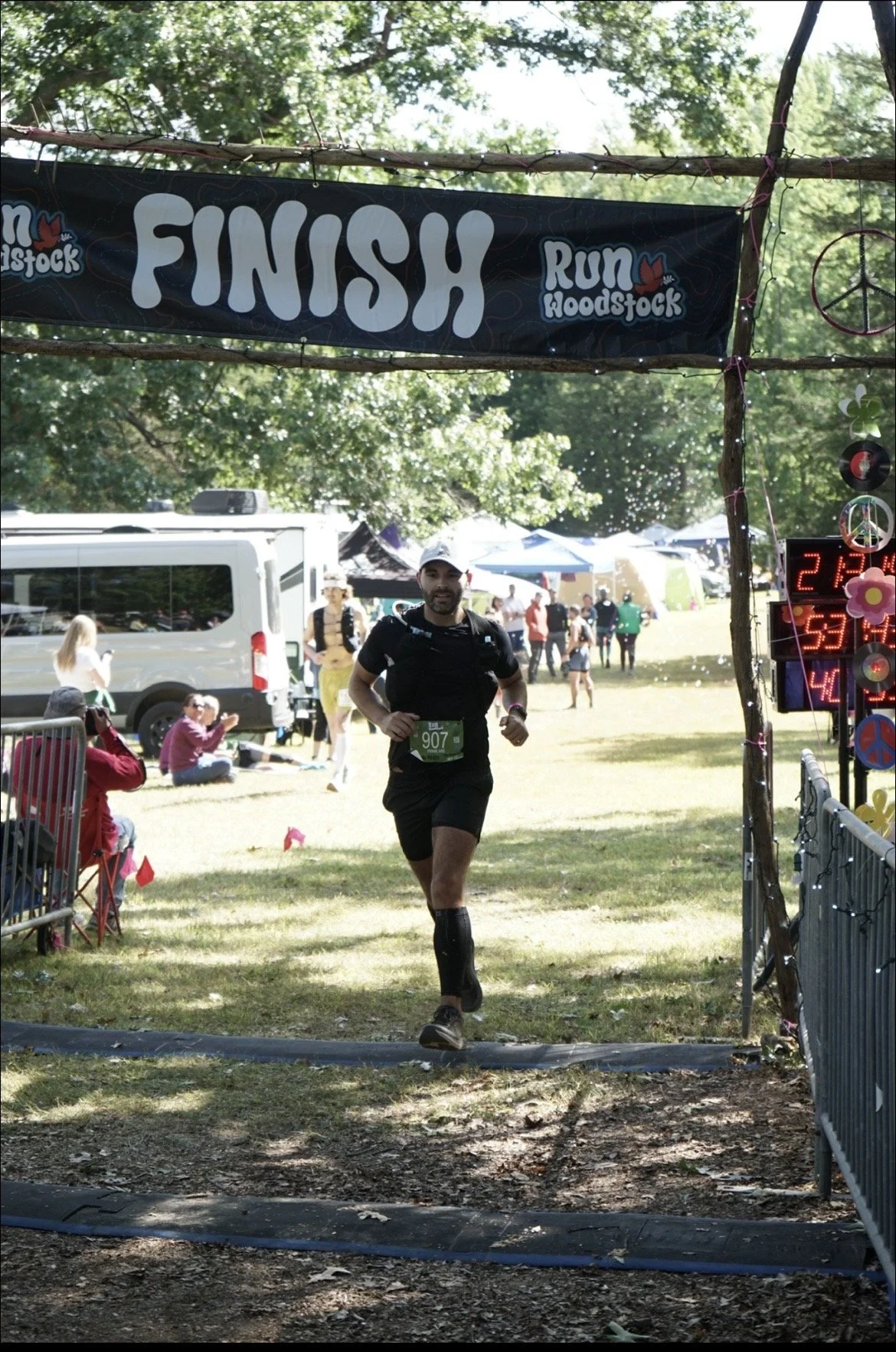
Crossing the finish line at the Run Woodstock Freak 50k. This was my first ultramarathon. Finished strong with a time of 05:31:09. Out of context, the all-black clothes and vest with tubes protruding would make me look like a character from a sci-fi movie, but it’s still less bizarre than seeing me shirtless.